


Pattern Imprinted Concrete vs Resin Driveways: Which Should You Choose?

Updated: 1 day ago
Choose pattern imprinted concrete if you want a bold patterned finish (cobble, slate, brick or stone effects) on a rigid slab and you don't mind resealing it every three to five years. Choose resin bound if you want a smooth natural stone finish that drains through on its own and needs no resealing. On published UK prices, resin over a sound existing base usually costs less per m² than imprinted concrete, but resin that needs a new base costs more.

Imprinted concrete vs resin at a glance
Cost: imprinted concrete about £100-£130 per m² (MyJobQuote); resin bound about £60-£95 per m² over a sound base, commonly £180-£250 per m² including a new base.
Lifespan: imprinted concrete 20 to 25 years or more with regular resealing; resin bound up to 25 years on a proper base.
Drainage: imprinted concrete is sealed and needs falls, channels or a soakaway; resin bound over a permeable base drains straight through.
Upkeep: imprinted concrete needs a reseal every three to five years; resin needs a sweep and an occasional wash.
Looks: imprinted concrete gives patterns, colours and borders; resin gives the texture of natural stone in one smooth layer.
Back in use: a car can usually go on resin after 24 to 48 hours; new concrete needs about 7 days before a car.
What is the difference between the two?
A pattern concrete driveway is a reinforced slab of concrete, coloured with a surface hardener, stamped with a pattern while it is still wet and then sealed. It mimics stone, brick, slate or cobbles and behaves like one solid surface.
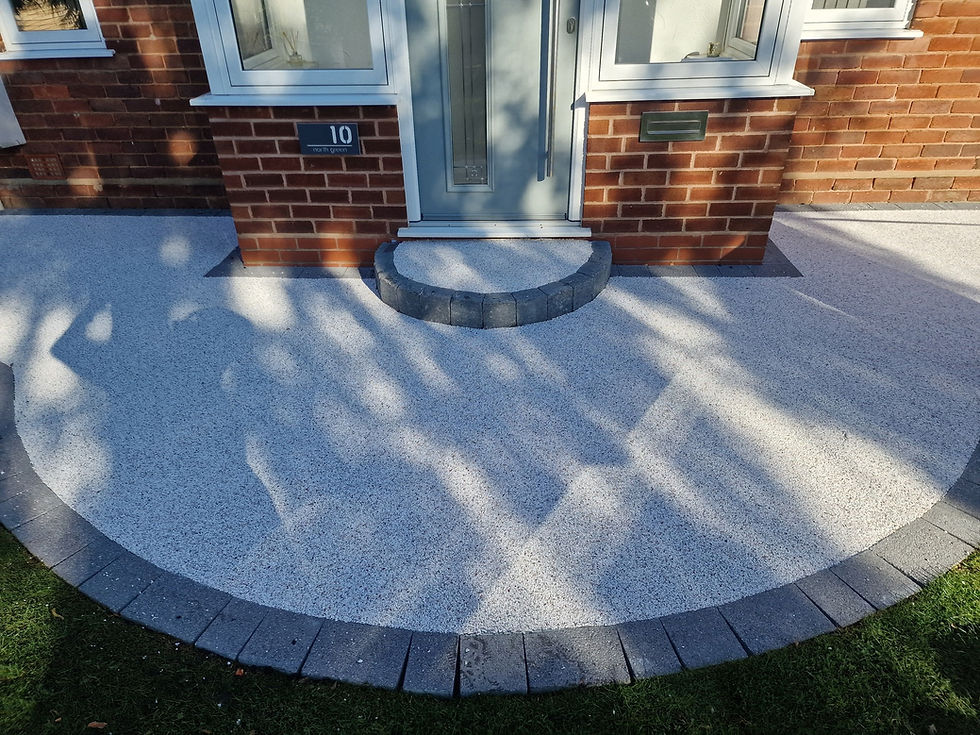
Resin bound surfacing is decorative stone mixed with a clear resin and trowelled onto a prepared base. On a driveway it is laid around 18mm deep. The finish is smooth and joint-free, and when it sits on a free-draining base the water passes straight through it.
Which costs more?
It depends on the base. Published 2026 cost guides put pattern imprinted concrete at about £100-£130 per m² (MyJobQuote). Resin bound is about £60-£95 per m² where the existing base is sound and needs little preparation (MyJobQuote), but commonly £180-£250 per m² when a new base has to be built (an industry figure quoted by Homebuilding & Renovating). On a 50m² drive that is roughly £5,000-£6,500 for imprinted concrete against £3,000-£4,750 for resin over a sound base.
In practice the dig-out, sub-base and drainage move the final price more than the surface does, so compare full quotes rather than headline rates.
Pattern imprinted concrete
Imprinted concrete driveway costs depend heavily on the depth of dig-out, reinforcement and the pattern chosen
Best suited to large areas or decorative finishes
Resin bound
Resin driveway cost depends mostly on whether a new permeable base is needed or a sound existing base can be used
Can rise further with intricate edging or colour blends
Which lasts longer?
Both last a long time when they are installed properly, but they age differently.
Pattern imprinted concrete
Strong, rigid slab that lasts 20 to 25 years or more
Needs resealing every three to five years to hold its colour and keep water and oil out
Can crack if the base is poor, the mesh is left out or the joints are not cut
Resin bound
Up to 25 years when laid on a proper base
Can crack and shed stone if laid too thin (driveways need at least 18mm) or over a cracked base
Non-UV resins yellow in sunlight; we use UV-stable resin, which holds its colour
Repairs are more visible because of stone variation

Which is easier to maintain?
Pattern imprinted concrete
A professional reseal every three to five years (UK cost guides put it at around £4 to £8 per m²)
Easy to clean with water and detergent
No joints, so no weeds growing up through the surface
Resin bound
No resealing needed, but an occasional wash keeps it bright
Organic debris left lying can let moss start in shaded corners
Tyre scuffs from dry steering can show on lighter blends, though most wash off

Which looks better?
That is taste, but the two give very different results.
Pattern imprinted concrete
Mimics cobblestones, slate, brick and more
Available in a wide range of colours and textures
Borders and dual-pattern designs add character
Works well with modern and traditional homes
Resin bound
Offers a smooth, natural stone finish
Particularly suits modern properties, though natural stone blends sit well on older homes too
Limited pattern flexibility
One continuous finish that can run from the drive into paths and patios
Drainage and planning
This is one of the main functional differences.
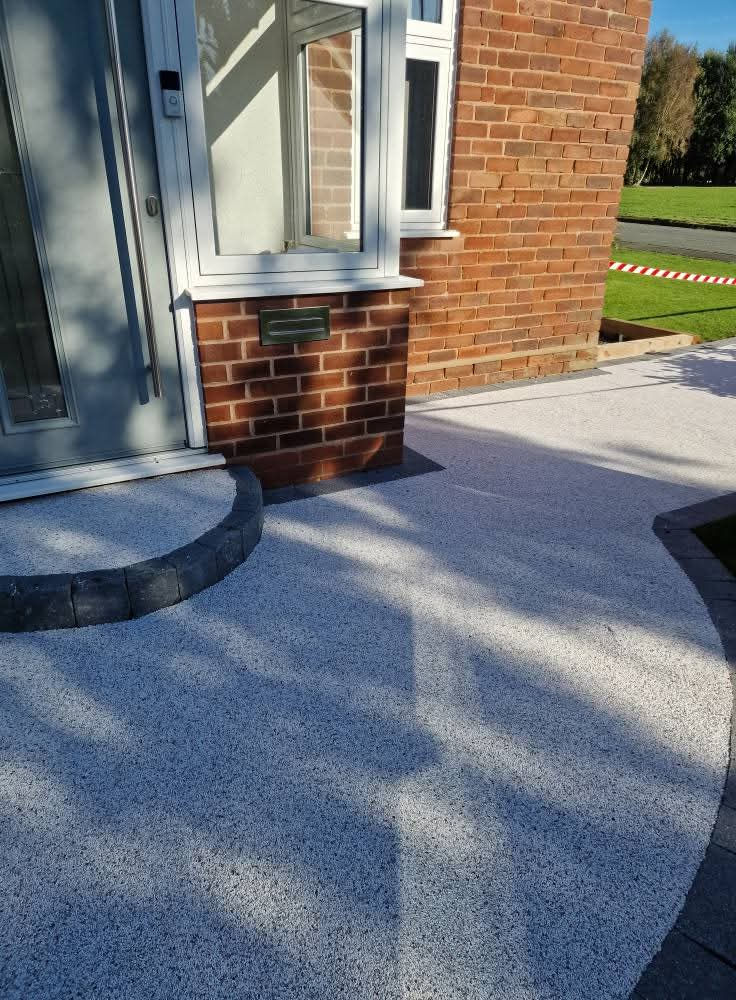
Resin bound surfaces are usually porous, so water can drain through the surface into a free-draining sub-base.
Pattern imprinted concrete is sealed and non-permeable, so surface water needs to drain to the sides or into installed channels.
It matters for planning too. In England, a new or replacement hard surface over five square metres in a front garden needs planning permission unless it is permeable or the rainwater runs to a lawn or border to drain naturally, as set out in the government's guidance on permeable surfacing of front gardens. Resin bound over a permeable base meets that on its own; imprinted concrete needs falls to a permeable area, a channel or a soakaway. Neither option is "better", but drainage needs to be handled properly in both cases.
Installation and weather
Both are weather-dependent. Neither resin nor concrete is laid below about 5°C, and resin cannot go down in rain or on a wet base, so resin dates move with the forecast. Imprinted concrete is poured, coloured and stamped in one go, then sealed once it has cured. Resin often has a base stage first, then the resin layer goes down in a day.
Once laid, resin is quicker to use: you can usually walk on it after 6 to 12 hours and drive on it after 24 to 48 hours. New concrete needs about 7 days before a car and 28 days before heavy vehicles.
Which should you choose?
Choose pattern imprinted concrete for a bold, decorative finish with wide design flexibility and a rigid slab that copes with heavy use, if you are happy to reseal it every few years.
Choose resin bound if you prefer a smooth, natural stone look, want the surface to drain on its own (useful for the front garden rule) and want almost no upkeep.
Where the old base is sound, resin is often the cheaper of the two; where everything has to be dug out and rebuilt, imprinted concrete often comes out cheaper.
If tarmac, block paving or exposed aggregate are also on your list, our guide to the best driveway material for UK homes puts all of them side by side.
We lay both from our base in Tettenhall, Wolverhampton, including the resin drives we lay with UV-stable resin, and we'll tell you on site which one suits your drive, whether the priority is looks, drainage or both.


Comments