


Hardstanding: What It Is and How to Build One Properly

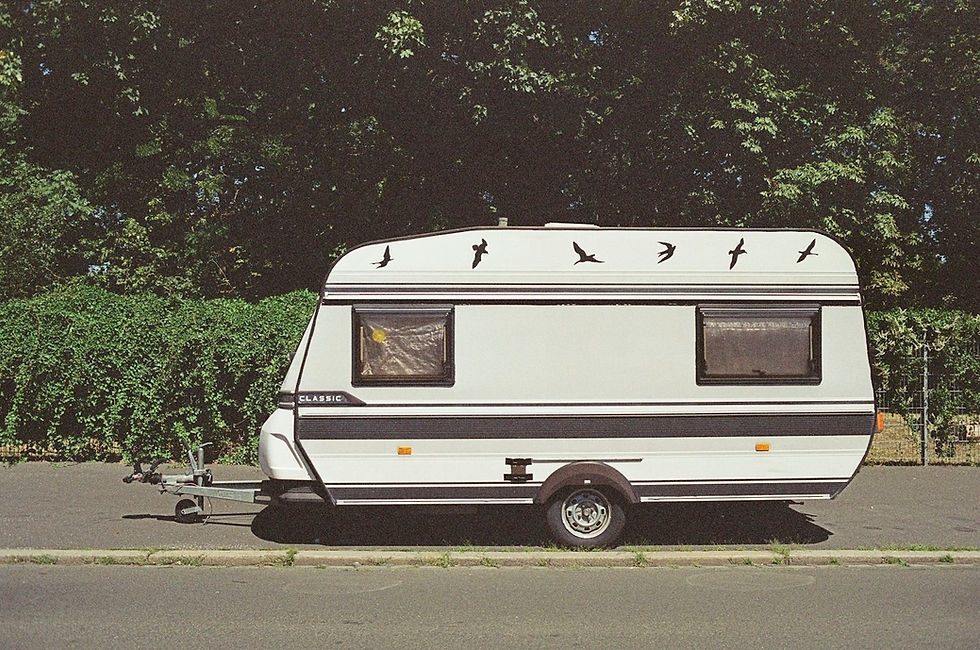
Hardstanding is any area of hard, load-bearing surface built for parking, storage or access: a concrete pad for a caravan, a parking bay at the side of a house, a base for a trailer or a yard behind a workshop. It's the word planners and builders use for the surface rather than the look, which is why it turns up in planning law as "hard surface". Most domestic hardstandings are concrete, tarmac or resin bound, and what decides whether one lasts is the base underneath and where the rainwater goes.
What counts as hardstanding?
Anything that turns soft ground into a surface that carries weight without rutting. In a domestic setting that usually means:
Parking pads beside or in front of a house, for a second car or a van.
Caravan and motorhome hardstanding, so a heavy vehicle isn't sitting on grass or sinking into gravel.
Trailer, boat and bin store bases.
Access tracks and yards on smallholdings and commercial sites.
A driveway is a type of hardstanding. So is a patio, technically, though nobody calls it that. The word mostly appears when the job is functional first and decorative second.
Do you need planning permission for hardstanding?
Often not, but the front of the house is where people get caught out. In England, laying a hard surface around a house for purposes incidental to living there is permitted development under Class F of the General Permitted Development Order 2015. The condition that matters sits in the same Class: where the hard surface is between the front wall of the house and a highway and covers more than 5 square metres, it must be made of porous materials, or the run-off must be directed to a permeable or porous area within the property.
In plain terms:
Back or side garden, away from the road: normally permitted, any material.
Front garden, under 5 square metres: permitted, any material.
Front garden, over 5 square metres: permitted only if it's permeable, or if the water drains to a lawn or border on your land. A solid concrete pad that drains into the road needs planning permission. The government's guidance on permeable surfacing of front gardens sets out the options.
These rights don't apply to flats or maisonettes, and they can be removed by a planning condition or an Article 4 direction, so check with the council if your estate or conservation area has restrictions. Separately, if you need to drive across a pavement or verge to reach the new hardstanding, you need the council's permission for a dropped kerb before you use it; gov.uk's dropped kerb page points you to your council's process.
How a concrete hardstanding is built
The base is the job. A pad that cracks or sinks almost always failed underneath, not on top.
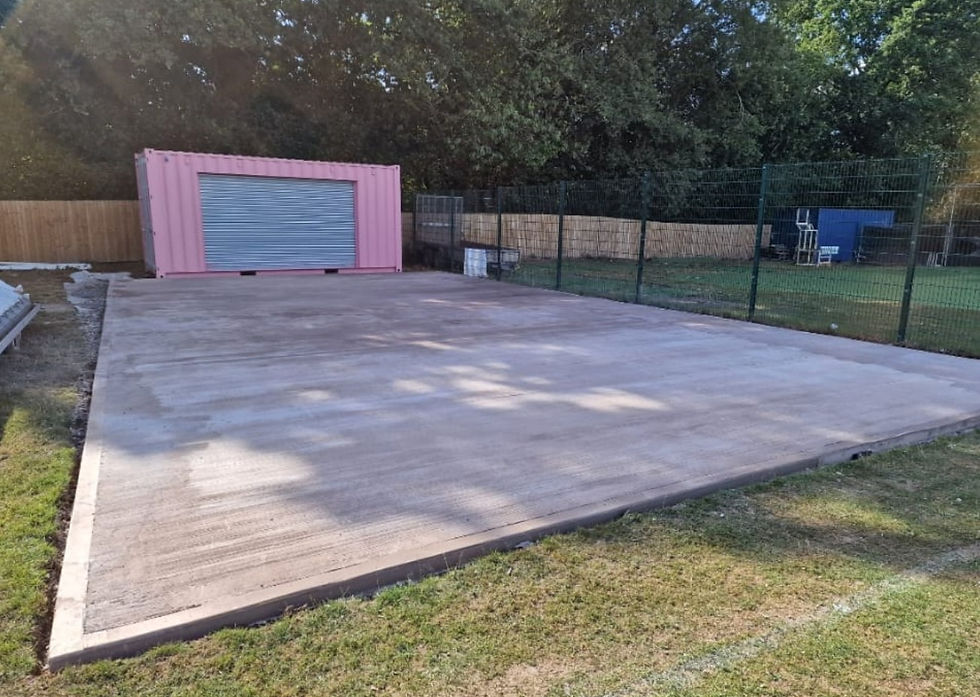
Strip and dig. All topsoil, roots and organic material come off. Soft spots are dug out and replaced, and old service trenches are backfilled and compacted in layers.
Sub-base. Well-graded crushed stone, compacted in layers. The LABC Warranty technical manual sets 100mm as the minimum for a light-duty domestic driveway and 150mm for medium duty (vehicles up to small lorries such as refuse or fuel deliveries). Ground that is weak or soft should have the sub-base designed by an engineer.
Forms and falls. The slab is set out to fall away from any building, at between 1:80 and 1:12 in the same guidance, so water never sits on it or runs to the house.
Concrete. LABC's minimum for a driveway slab is 100mm for a typical family car, increased to 150mm on poor ground or clay, with more again where heavier loads are applied. A motorhome pad or a commercial yard is a heavier-load case and should be designed thicker, usually with mesh.
Joints. In-situ concrete is laid in bays of no more than 20 square metres in the LABC guidance, with a maximum bay length of 6m and a flexible isolation joint where it meets a wall.
Cure. Cars after about a week, heavy vehicles after 28 days.
Concrete, tarmac or resin for hardstanding?
All three work. They suit different jobs.
Concrete is the strongest choice for point loads: caravan jockey wheels, motorhome legs, axle stands and trailer hitches all sit on a small area and press hard. A rigid slab spreads that load. It can be plain and brushed for a purely practical pad, or finished as pattern imprinted concrete or exposed aggregate when it's at the front of the house and has to look the part.
Tarmac is usually quicker and cheaper over large areas, and suits access tracks and yards. It is a flexible surface, so a narrow, heavy point load such as a jockey wheel or corner steady left in one spot on a hot day can mark it.
Resin bound is permeable, so a front hardstanding over 5 square metres can meet the planning rule without a drain, provided it's laid on a permeable base. It's a surface, not a structure, so it needs a strong base under it.
Caravan and motorhome hardstanding
A caravan or motorhome is the most common reason people search for hardstanding, and it's where corners get cut. A few points worth holding a quote to:
Size it for the vehicle plus room to walk round it, and for the door side to open onto the pad, not grass.
Build for the heaviest load, which is a motorhome rather than a car. Ask what slab thickness and sub-base depth are being quoted.
Plan the approach. The weakest point is often where the vehicle turns onto the pad from the drive. Edges there take the wheel load.
Check your deeds. Some estates have covenants on parking caravans or commercial vehicles, separate from planning.
Hardstanding questions, answered
Is gravel classed as hardstanding?
Loose gravel is a hard surface in planning terms and is generally permeable, but it ruts under heavy wheels and spreads unless it's held in a grid. For a caravan or motorhome it's the weaker option.
Does a concrete hardstanding need sealing?
A plain brushed pad doesn't have to be sealed. A decorative imprinted or exposed aggregate surface does, to hold its colour and keep oil out; our guide to imprinted concrete sealer covers when and how.
How long does a concrete hardstanding last?
Built on a proper base, decades. Upkeep is light: sweep it, keep drains clear and reseal any decorative finish every few years, as set out in our imprinted driveway maintenance guide.
Drive Tech lays tarmac, imprinted concrete and resin bound drives, plus commercial yards and access roads, around Wolverhampton, Telford and the Black Country. If you're planning a plain concrete or caravan pad, ask any installer whether they build that type of slab and what thickness they'd quote. To talk through a parking area at your property, get in touch and we'll come out to look at the ground and the access.


Comments